




Ecommerce is hard enough without watching your CAC creep up every quarter. When it happens, most teams reach for the same lever: cut spend, or overhaul which channels the budget goes to. We get why. Chasing a lower number feels like doing something. But the number that matters is the CAC you can afford, built through retention, customer lifetime value (LTV), and genuine demand.
Why CAC rises when nothing in the ad account has changed
Three things push CAC up without anyone in the ad account doing anything wrong. Auctions get more expensive as more advertisers compete for the same attention, so reaching the same audience costs more than it did a year ago. Creative fatigue works the same way: an audience that has seen an ad enough times stops responding to it, and that decay sets in before a team notices the pattern.
The third sits outside the ad account entirely. If the brand has changed what it does everywhere else, paid media inherits the difference: fewer emails, a quieter organic calendar, a promotion pulled, a wholesale or retail presence scaled back. Demand that used to arrive warm now has to be bought, and the account looks like it has got worse at its job when the job itself has changed.
Two of the three are the auction doing what an auction does. The third is a decision someone in the business made, and it will not show up anywhere in the ad account.
The 3:1 rule is a compass. Most teams read it as a scoreboard.
Lifetime value (LTV) is roughly what a customer is worth to your business over time. The 3:1 rule says a customer should be worth about three times what it cost to acquire them. It was built as a general guide, and that's still the right way to use it. Where teams go wrong is what they do with it: treat it as a line to clear, panic below it, relax above it.
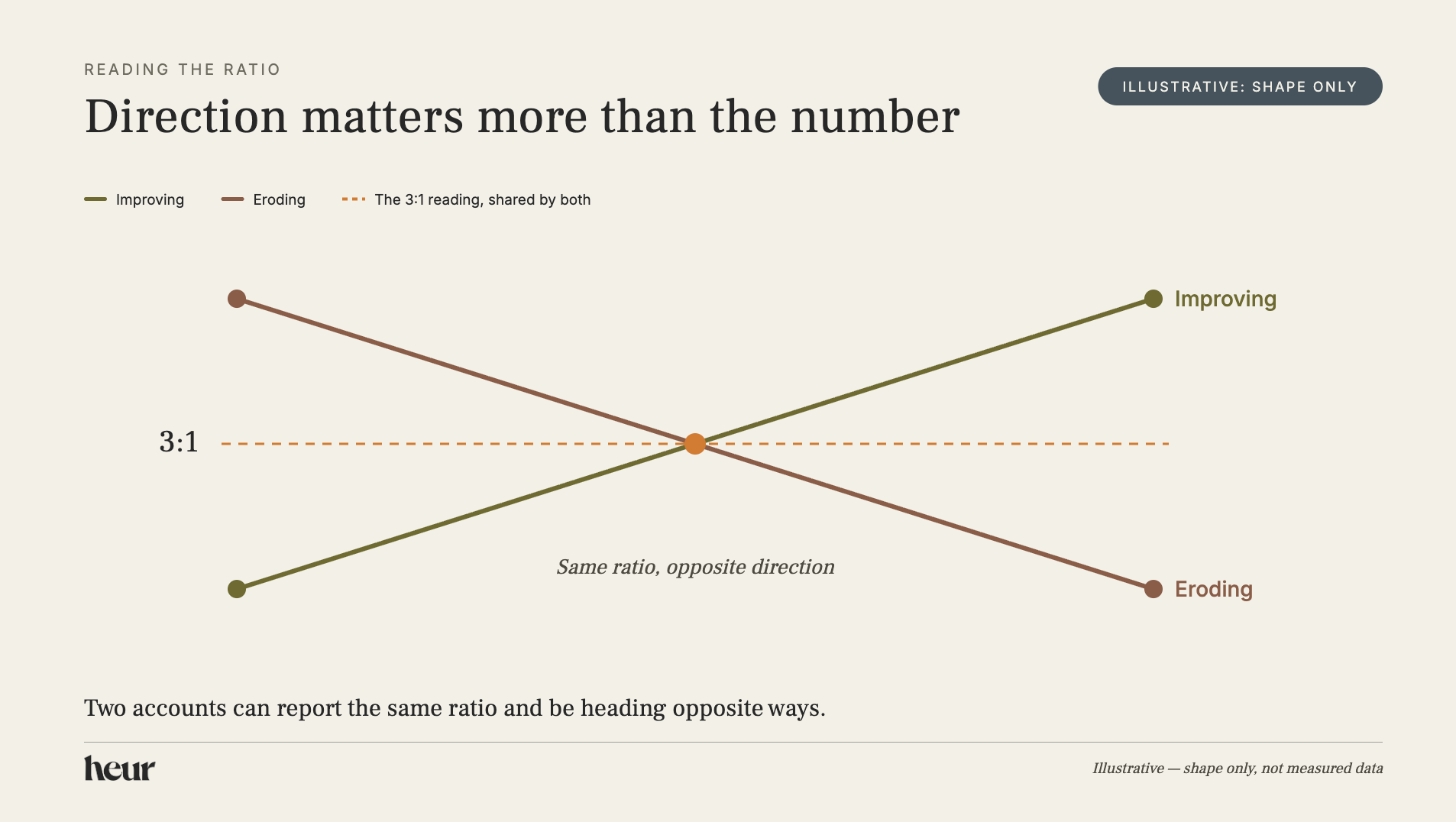
The ratio moves for one of two reasons: what you're paying to acquire a customer, or what they're worth once you have them, which comes down to retention. The same 3:1 can hide either story, and the table below shows which:
Only the direction tells you which one you're in. A single snapshot can't.
What you can afford to pay depends on when you need the money back
The 3:1 rule assumes lifetime. Your cash flow does not: the next stock order has a date on it. So the more useful question is what a customer is worth by the date you need the money back.
Pick the window first. Three months is a common one because it maps to a stock cycle. Then work out the profit a new customer delivers inside that window, after discount, shipping, returns and cost of goods. That figure is the most you can pay to acquire them and still break even by your own deadline.
Subscription is where a single blended target starts to mislead. A subscriber and a one-off buyer are not worth the same by month three, so the ceiling has to be a weighted average of the two, moving with the mix. When the subscription share of new customers rises, the CAC you can afford rises with it. When the mix moves back toward one-off buyers and nobody re-runs the maths, the target quietly becomes too generous.
Then set your working target below the ceiling. The ceiling is break-even, and break-even is not a plan.
The tell: cutting spend before diagnosing anything
When CAC rises, the reflexive move is to cut media spend or overhaul the channel mix, meaning which platforms and ad formats get the budget, overnight. You end up punishing the channel for a weak offer. Before touching the budget, ask whether the problem is even in the channel. Usually it isn't. A tired offer makes every channel look expensive. A positioning that's drifted from the market makes every audience look unresponsive. Cutting spend in either case shrinks the business while the underlying problem sits untouched.
Channel and creative matter. They're rarely where the problem starts.
When spending more is the right call
Meta rebuilt how it decides which ads a person sees, moving from advertiser-defined targeting toward reading the ad itself and predicting who'll respond to it. As Meta's own engineering team describes it, this stage is "tasked with selecting ads from tens of millions of ad candidates into a few thousand relevant ad candidates." That is why testing toward market fit earns its budget: cut it too early and you lose the customers the testing would have found.
That gets read as permission to go broad and let the creative do the rest. On the premium and luxury apparel accounts we run, that has not been our experience at the top of the funnel, where we still hold a level of audience control. The system is good at finding more people who look like the ones already responding, which is the problem when the ones already responding are the wrong ones, or when there are too few of them for the signal to carry. Broad works when the pool is large and the product is mainstream. Where the buyer is narrow and the price point does the qualifying, give the platform a starting point.
Neither is permission to spend without limit. Each has a specific job: learn something, or build something, that a lower CAC target would have cut off too early.
If the CAC conversation keeps landing on the channel and never on the offer, check the offer next. Get the diagnosis right before the budget gets touched, and the rest follows: a brand that can keep affording to acquire, instead of one that's just spending less every quarter to stay afloat.
Frequently asked questions
Is a 3:1 LTV:CAC ratio always the right target?
It's a solid general benchmark, not a fixed rule. Direction matters more than hitting the number, and so does whether the retention behind it is holding. If you sell on subscription, work from a payback window: the profit a customer delivers by the month you need the cash back, weighted across subscribers and one-off buyers.
Why does my CAC keep rising even when I haven't changed anything?
Auction dynamics shift and creative fatigues, and both matter. The cause people miss sits outside paid media: if the brand has pulled back anywhere else, demand that used to arrive warm now has to be bought. Offer, positioning or product fit drifting out of step with the market does the same thing, and makes every channel look worse than it is.
Should I ever increase ad spend when CAC is already rising?
Yes, in two situations: when you're testing broadly enough to help the platform learn who responds, or when you're investing in demand that won't show up as lower CAC for months.
What to check before you touch the budget
1. Look at the LTV:CAC trend over the last few months. Is this a snapshot problem or a direction problem?
2. Work out what you can afford to pay by your own payback date, split by customer type if some of them subscribe.
3. Ask if the offer still earns attention. Soft conversion everywhere is rarely a channel issue.
4. Check whether positioning still matches who's buying.
5. Only then look at spend and creative. Fifth question, never first.