




- The decision was made before it reached the ad account
- When you should pause ads for an out-of-stock product
- What you gain by keeping a sold-out product live
- Why automating this on stock levels goes wrong
- Seven things you can do, and what each one costs
- Keep your feed and your page saying the same thing
- How we run this with clients
- Common questions
A product is a week from running out and someone asks whether to keep the ads running. By the time that question reaches the ad account, the decision that mattered was already taken somewhere else: in the buying meeting, in the drop plan, or in the reorder nobody placed. Paid media inherits the consequence and gets asked to fix it with a lever that was never going to work.
You do still have choices at that point. There are seven of them, each one costs something different, and which ones are open to you depends on five questions that have nothing to do with your ad platform. Work through both now, and the next time it happens you will be choosing rather than reacting.
The decision was made before it reached the ad account
A sell-out is a planning outcome, and the ad account sits downstream of it.
A sell-out you planned is a demand signal you have already paid for and should now go and collect. A sell-out that caught you out is a bill. Those two look identical on a stock report and behave like completely different events inside the business, and nobody working in the ad account can make the second one behave like the first. They can only decide what to do with whichever one they have got.
Two questions settle which of the four you are in.
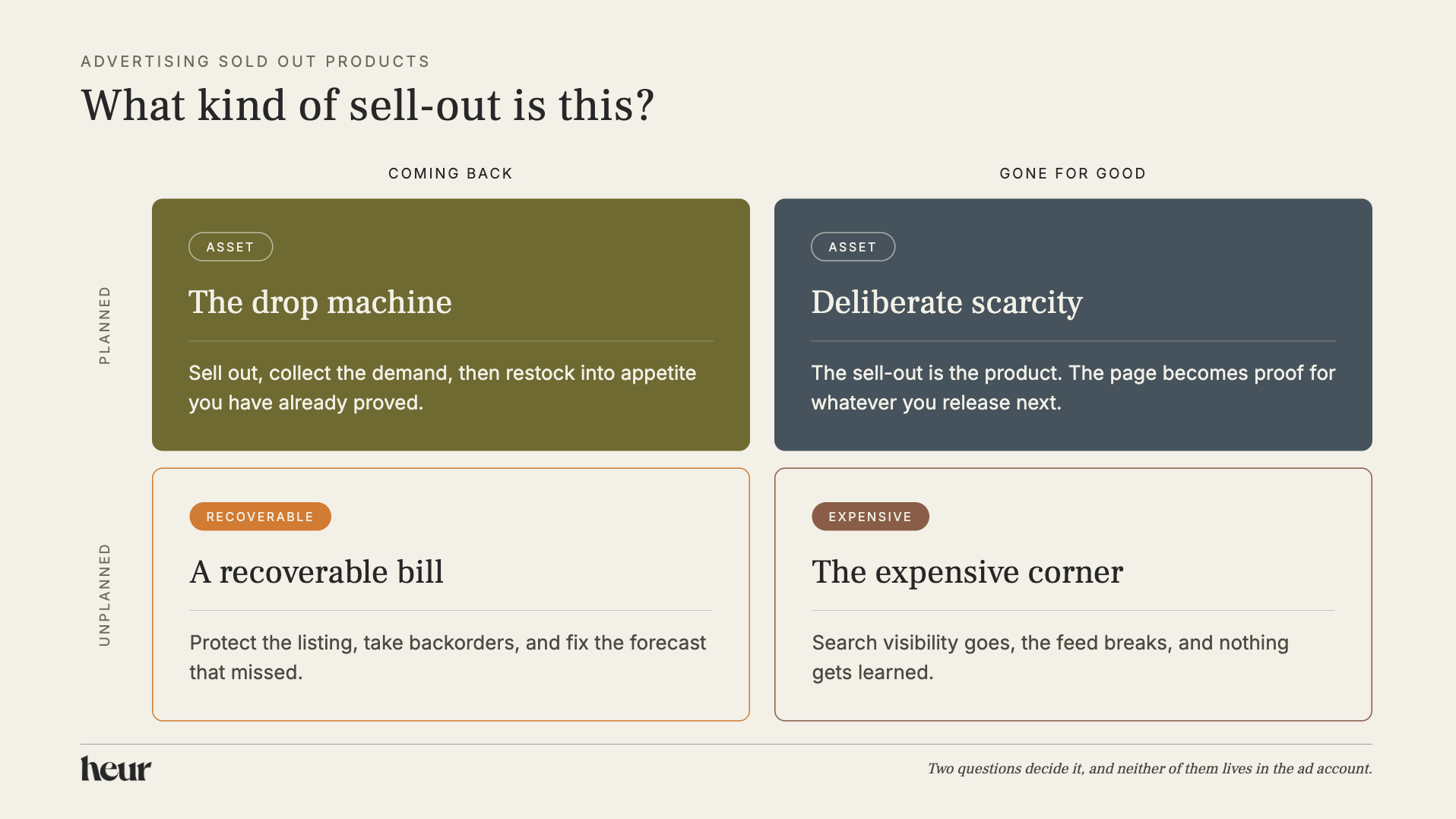
That is why "should we pause the ads" is such an unsatisfying question to be handed. It has a real answer, and it arrives about six weeks after the last point at which anything could have been changed. Ask it anyway. Then ask the better one, which is what the business wants this sell-out to produce.
When you should pause ads for an out-of-stock product
Pausing is a legitimate answer, and the argument for it is stronger than the people who wave it away tend to admit.
You pay for clicks that cannot convert, so every pound reaching that product buys nothing. You disturb an ad set that had settled, and getting it back to where it was is slower and more expensive than the pause looked at the moment you made it. And you send someone meeting your brand for the first time to a page they cannot buy from, which is the cost nobody puts a number on, because that single visit becomes their whole impression of you.
There is a version of this where pausing is correct and everything else on this page is noise. One product, nothing adjacent for the click to reach, no restock date, no way to take money now. The traffic has nowhere to go and the spend buys you nothing at all, so pause it and move the budget somewhere it can work.
That case describes a specific business in a specific position. Whether it describes yours is the whole question, and the five questions further down are how you find out. One thing to avoid on the way there: deleting the product to stop it serving, because Google warns that an offer added back after deletion takes a significant amount of time before it can show again.
What you gain by keeping a sold-out product live
A sell-out you saw coming is the cheapest demand research available to you, and pausing everything throws it in the bin.
You get a read on the next buy that no forecast will match, because the people signing up to hear about a restock have told you something a forecast can only estimate. You learn whether to reorder or carry over, which is a call most brands make on instinct in about four minutes and then live with for a season. The waitlist stops being a marketing list and starts being an instrument.
There is a reputational return on top of that. Selling out is public evidence that other people wanted the thing, and Shopify's research on limited releases found a meaningful share of shoppers say a limited-edition label makes them likelier to buy. The page stops selling this product and starts selling the next one.
None of that arrives on its own. It arrives when the page is still there, still says something worth reading, and still collects an email address.
What an unplanned sell-out costs beyond the lost sales
An unplanned sell-out costs you more than the revenue you did not take, and most of the extra lands somewhere nobody thinks to look.
Your spend redistributes itself. When a strong converter drops out of a campaign the money does not stop; it moves onto products that convert less well, so your blended numbers get worse while every setting in the account stays exactly where you left it. Someone then asks why performance dipped, and the answer is sitting in a stock report that paid media never sees.
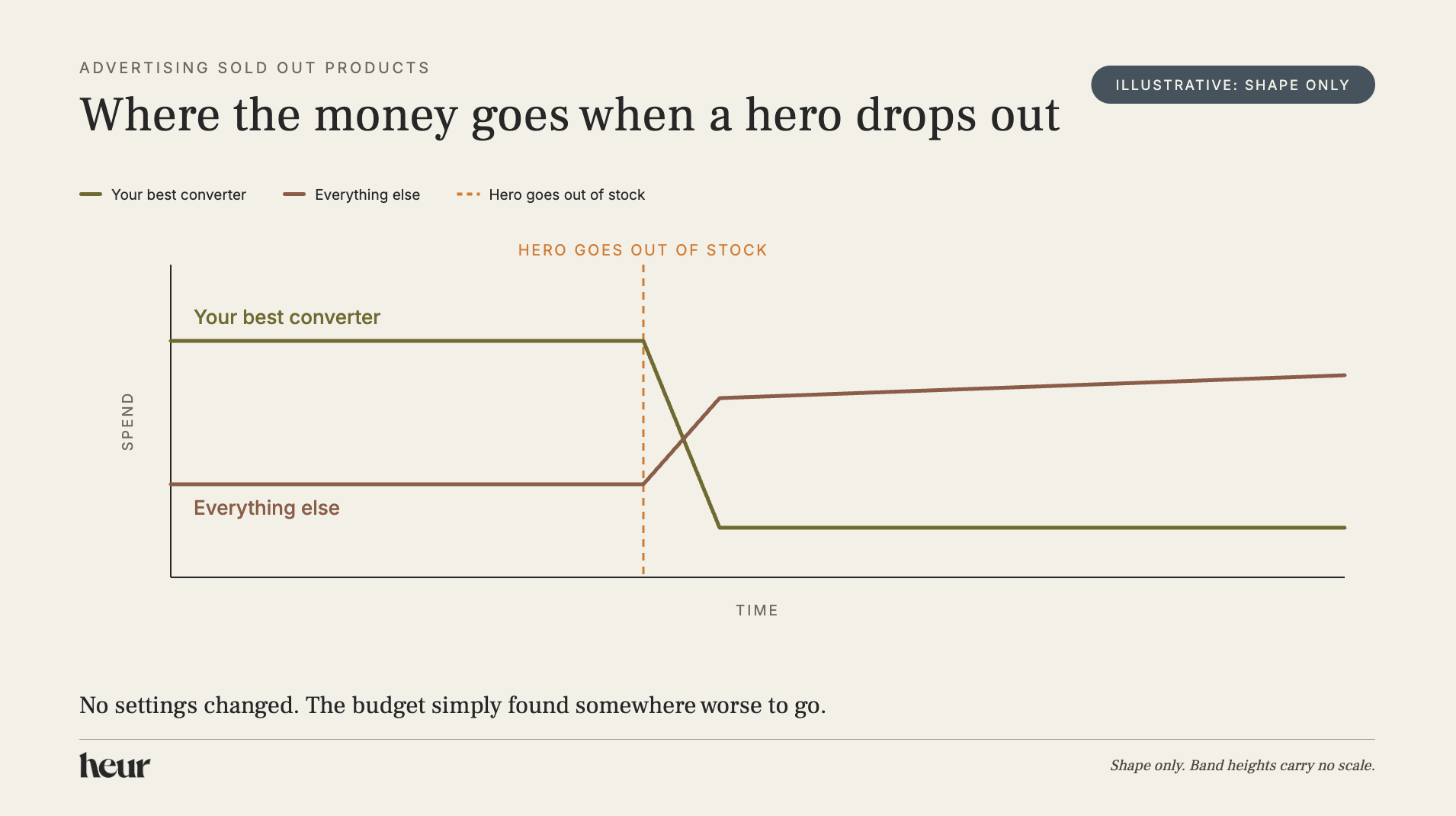
Your feed and your pages start disagreeing with each other, which is the point where an operational problem quietly becomes a policy one. Your customer sees a store that looks unplanned, because a sold-out hero with no message on it reads as neglect, where the same page carrying a return date reads as demand.
Put all of that together and the ad decision is the smallest line on the bill.
Why automating this on stock levels goes wrong
Stock velocity looks like the obvious trigger and breaks on the first brand-driven decision it meets.
A rule that watches units per day and pulls spend when the number drops treats a deliberate sell-out as a fault. It will be wrong in three ordinary cases:
- A drop is built to run out, so selling out means the plan worked.
- A seasonal line ends when the season does, and hitting that date is the target.
- A collaboration sells through in a weekend because someone designed it to.
A rule reading velocity on its own will defund all three at the moment they are working.
Brand decisions are not linear, so a linear rule cannot hold them. Velocity still earns a place as one input into the questions below, and as a floor for the case nobody planned, where any rule beats nobody watching. It does not get to make the call.
Five questions to answer before you decide
Answer these five and the seven outcomes below narrow to the two or three you can pick from.
The second question governs the rest of them. Ahrefs' guidance on out-of-stock products separates temporary from permanent before anything else gets decided, and that is the right order to work in. A product returning in three weeks and a product gone for good share almost nothing.
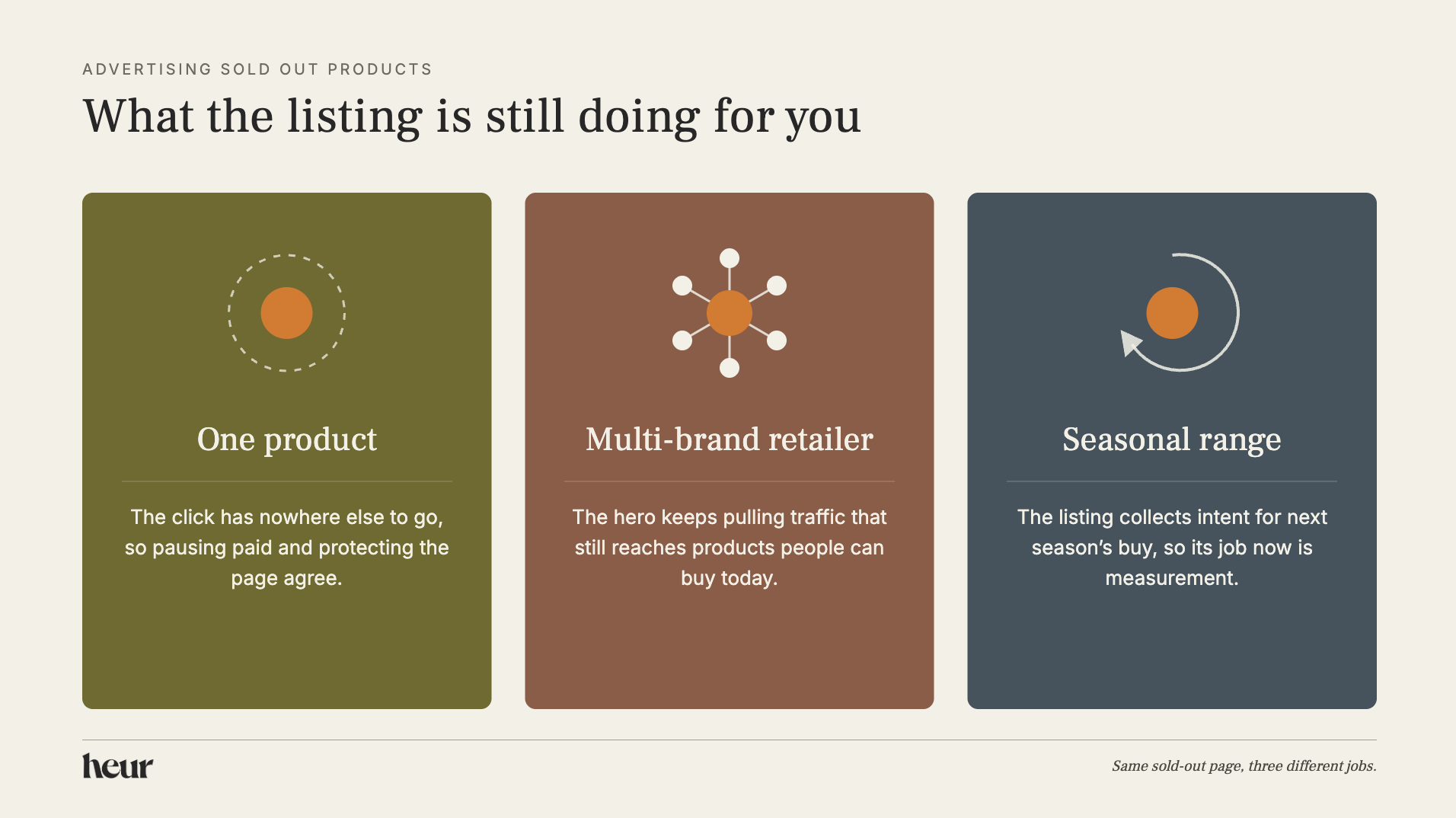
The fifth question is really asking what kind of business you run, and three shapes come up again and again:
- One product, or close to it. The listing carries most of your search presence, and there is nothing adjacent to send the click to. Pausing paid and protecting the page usually pull in the same direction here.
- A retailer carrying other people's brands. The hero keeps pulling traffic, and where product pages link properly back to the brand, that traffic still reaches things people can buy. Keeping it live does work here that it does nowhere else.
- A seasonal range. The listing is a demand instrument for next season's buy. Its job after the sell-out is collecting intent for the reorder.
Seven things you can do, and what each one costs
Pick the outcome you want, then accept its price. You cannot have all seven, and two of them contradict each other outright.
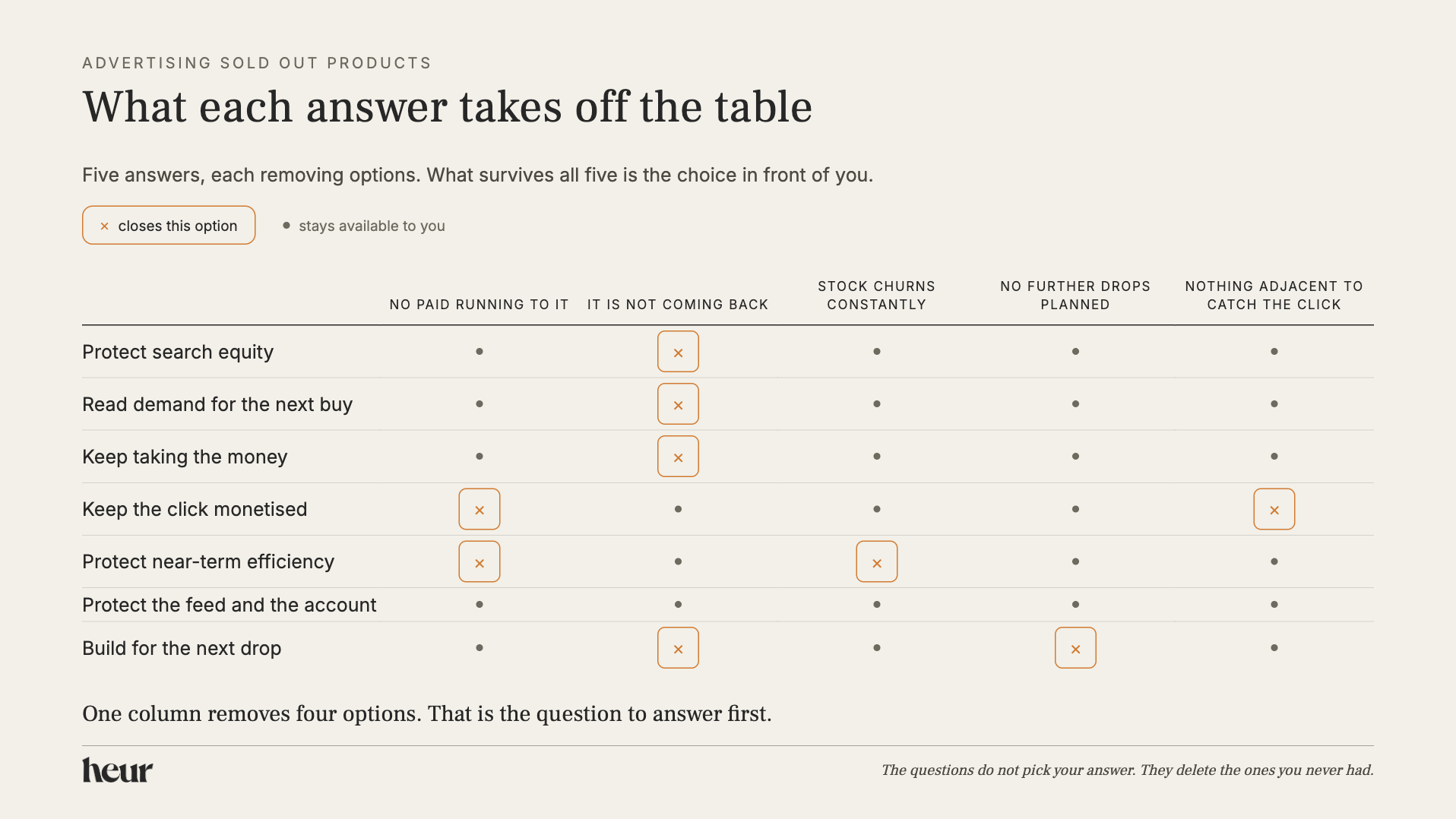
Reading demand and protecting near-term efficiency cannot both be true at once. Reading demand costs you efficiency this month, and protecting efficiency this month costs you the read. That trade is at the centre of the whole decision, and the brands who believe they have escaped it have usually picked one without noticing.
Three of those outcomes carry platform rules worth knowing before you commit to them. If you keep taking the money, Google's product data specification requires a visible availability date on backordered items, so "back soon" will not do.
If you protect near-term efficiency, know what the pause costs. Google archives any product paused for longer than 14 days, and a reactivated one can take a further day or more to start showing again.
And if you protect search equity, treat it as a bet with a downside. Search Engine Journal's write-up of Google's guidance notes that out-of-stock pages can be treated as soft 404s and dropped from results, and that pulling a page and restoring it later does not automatically put it back where it was. Keeping the listing live is the better play in most temporary cases, and it is still a play.
Keep your feed and your page saying the same thing
A feed that disagrees with your product page turns an operational problem into a policy one, which is a far more expensive category of problem.
The tempting move, when a hero goes down mid-flight, is to leave the listing marked as available so delivery continues while you sort the stock out. Google's specification is blunt about it: availability has to match across your data source, your landing page and your checkout, and a mismatch disapproves the product. Promoting products as available when they are unavailable falls under the misrepresentation policy, which is enforced at account level.
Use the controls built for the job. One pause mechanism exists for short interruptions and a separate one for holding a product back from particular surfaces, and both are safer than editing availability to force a delivery outcome.
How we run this with clients
We bring the demand data into the buying conversation and let the client's team make the call with it in front of them.
The line between buying, merchandising and ecommerce is blurred at most brands, and nobody owns this decision cleanly. So it gets made on instinct by whoever notices first, and the instinct is usually a guess about what customers will think. Everyone in that meeting is capable of a better decision. They are missing the evidence, not the judgement.
What ecommerce can see and the buying team usually cannot is the shape of the demand: where traffic to that product comes from, how it converts, what a waitlist says about intent, what happened across the rest of the account the last time this product went down. Put that in the room and the conversation changes character. Then the plan gets written down before the next product runs down, while everyone is calm and nothing needs deciding today.
That shifts who owns the call, which is the point of doing it at all. Nobody wants paid media making merchandising decisions, and nobody wants merchandising finding out about the ad consequences a fortnight later.
Common questions
Does an out-of-stock product page hurt your SEO?
Not on its own, though it carries a risk worth knowing about. Google can treat a page for an unavailable product as a soft 404 and drop it from results, particularly when nothing useful is left on the page. Keep the page live for anything coming back, say when it returns, and give the visitor a next step.
Should you pause Google Shopping ads when a product sells out?
Shopping stops serving on its own once your feed reports the product as unavailable, so the live question is search and social, where nothing pauses automatically. Decide by outcome: pause for efficiency now, route the click elsewhere if you have adjacent product, or keep going if you can take backorders.
Can you keep advertising a product on backorder?
You can, and Google supports backorder directly as an availability value, provided you attach a date the customer can see on the landing page. The commercial question is harder than the technical one, because you are selling a delivery promise and your support inbox is the first place to hear about a date you missed.
How long should you keep a sold-out product page live?
For as long as the product is genuinely coming back, plus a margin for slippage. No fixed point exists at which the page stops earning its keep, so let the product decide that question and leave the calendar out of it. Once it is gone for good, redirect to the closest equivalent product or retire the URL properly.
What to agree before the next product runs out
Do this while nothing is on fire, because every part of it gets harder in the week it matters.
- Get stock data in front of paid. Weekly, at SKU level, expressed as days of cover. Most bad calls happen because the ad account found out late.
- Answer the five questions for your top 20 products now. Most will give the same answers, which is what makes them a rule you can apply instead of a meeting you have to hold every time.
- Set a default outcome per product type. Seasonal ranges read demand for the next buy, one-off collaborations build for the next drop, and core lines protect efficiency because they come back quickly.
- Name who decides. One person, with a route into the buying team, and the authority to leave spend running on something that is nearly gone.
- Fix the feed before you need it. Availability consistent across your platform, your feed and your page, so a stock problem stays a stock problem.
- Write the restock message once. A page that says when the product returns and takes an email address does more work than most of the rest of this.
If you got to the five questions and realised two of them need somebody from the buying team in the room, you have found the thing worth fixing first. Most of the brands we work with started exactly there, and the conversation was shorter than they expected. We are glad to be in that room when it helps.